Rigid body game physics
24 Oct 2019part 1 part 2 part 3 part 4 part 5 part 6
Update: See Getting started with the Jolt Physics Engine
Inspired by Hubert Eichner’s articles on game physics I decided to write about rigid body dynamics as well. My motivation is to create a space flight simulator. Hopefully it will be possible to simulate a space ship with landing gear and docking adapter using multiple rigid bodies.
The Newton-Euler equation
Each rigid body has a center with the 3D position c. The orientation of the object can be described using a quaternion q which has four components. The speed of the object is a 3D vector v. Finally the 3D vector ω specifies the current rotational speed of the rigid body.
The time derivatives (indicated by a dot on top of the variable name) of the position and the orientation are (Sauer et al.): \[ \dot{c} = v\mathrm{,\ }\dot{q} = \frac{1}{2} \omega q \] The multiplication is a quaternion multiplication where the rotational speed ω is converted to a quaternion: \[ \omega = 0 + \omega_1 i + \omega_2 j + \omega_3 k \]
In a given time step Δt the position changes as follows \[ c^{t+\Delta t} = c^t + v \Delta t \]
The orientation q changes as shown below \[ q^{t+\Delta t} = q^t + \frac{1}{2} \omega q \Delta t \] Note that ω again is converted to a quaternion.
Given the mass m and the sum of external forces F the speed changes like this \[ v^{t+\Delta t} = v^t + \frac{1}{m} F \Delta t \] In other words this means \[ \dot{v} = \frac{1}{m} F \]
Finally given the rotated inertia matrix I(t) and the overall torque τ one can determine the change of rotational speed \[ \omega^{t+\Delta t} = \omega^t + I(t)^{-1} (\tau - \omega \times I(t) \omega) \Delta t \] Or written as a differential equation \[ \dot{\omega} = I(t)^{-1} (\tau - \omega \times I(t) \omega) \]
These are the Newton-Euler equations. The “x” is the vector cross product. Note that even if the overall torque τ is zero, the rotation vector still can change over time if the inertial matrix I has different eigenvalues.
The rotated inertia matrix is obtained by converting the quaternion q to a rotation matrix R and using it to rotate I₀: \[ I(t)=R(q^t) I_0 R(q^t)^\top \]
The three column vectors of R can be determined by performing quaternion rotations on the unit vectors. \[ R(q) = \big( q \begin{pmatrix}1 \\ 0 \\ 0 \end{pmatrix} \bar{q}, q \begin{pmatrix}0 \\ 1 \\ 0 \end{pmatrix} \bar{q}, q \begin{pmatrix}0 \\ 0 \\ 1 \end{pmatrix} \bar{q} \big) \] Note that the vectors get converted to quaternion and back implicitely.
According to David Hammen, the Newton-Euler equation can be used unmodified in the world inertial frame.
The Runge-Kutta Method
The different properties of the rigid body can be stacked in a state vector y as follows. \[ y = \begin{pmatrix}c_1 & c_2 & c_3 & q_1 & q_2 & q_3 & q_4 & v_1 & v_2 & v_3 & \omega_1 & \omega_2 & \omega_3\end{pmatrix}^\top \] The equations above then can be brought into the following form \[ \dot{y} = f(t, y) \] Using h=Δt the numerical integration for a time step can be performed using the Runge-Kutta method: \[ \begin{equation*} \begin{split} y^{t+h} &= y^t + \frac{1}{6} (k_1 + 2 k_2 + 2 k_3 + k_4)\\ k_1 &= h f(t, y^t)\\ k_2 &= h f(t + \frac{h}{2}, y^t + \frac{k_1}{2})\\ k_3 &= h f(t + \frac{h}{2}, y^t + \frac{k_2}{2})\\ k_4 &= h f(t + h, y^t + k_3) \end{split} \end{equation*} \]
The Runge-Kutta algorithm can also be formulated using a function which instead of derivatives returns infitesimal changes \[ y^{t+h} - y^t = f(t, h, y) \]
The Runge-Kutta formula then becomes \[ \begin{equation*} \begin{split} y^{t+h} &= y^t + \frac{1}{6} (k_1 + 2 k_2 + 2 k_3 + k_4)\\ k_1 &= f(t, h, y^t)\\ k_2 &= f(t + \frac{h}{2}, h, y^t + \frac{k_1}{2})\\ k_3 &= f(t + \frac{h}{2}, h, y^t + \frac{k_2}{2})\\ k_4 &= f(t + h, h, y^t + k_3) \end{split} \end{equation*} \]
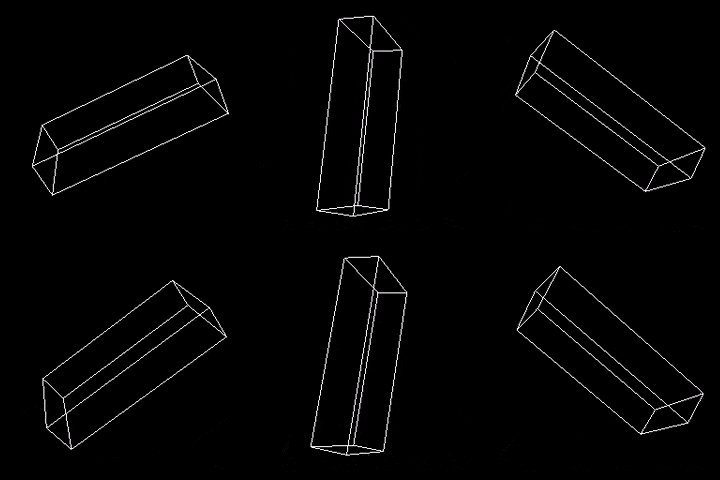
Using time-stepping with F=0 and τ=0 one can simulate an object tumbling in space.